
Design Thinking Is Not Enough: Why Framing Matters
Design thinking book review

One of the most important characteristics of design is its ambition to move from an existing situation to a better one. Design is not only about making attractive products, services, or experiences. At its core, design is about improvement. It asks: What is happening now? Why is it not working? What could be different? And how might we move towards a more meaningful outcome?
But this movement from a current condition to an improved one is not possible without first understanding the problem. This is where Kees Dorst’s book Frame Innovation becomes especially valuable. Dorst reminds us that complex problems cannot be solved simply by applying ready-made methods or rushing towards ideas. Before we can create better solutions, we need to examine how we are looking at the problem in the first place.
In Frame Innovation, Dorst explores the relationship between problem frames and solution frames. A frame is a way of seeing. It shapes what we notice, what we ignore, what questions we ask, and what kinds of solutions we imagine. For example, a city’s transport issue could be framed as a problem of infrastructure, behaviour, sustainability, accessibility, or quality of urban life. Each frame leads to a different direction for design. The same situation can produce very different solutions depending on the frame used to understand it.
This is one of the book’s strongest contributions. Dorst challenges the idea that design is a simple step-by-step journey from problem to solution. Many design thinking models begin with exploration, move into definition, and then progress towards ideation, prototyping, and testing. These models are useful, especially because they encourage divergent and convergent thinking. However, Dorst shows that real design work is often less linear and much more reflective.
Designers do not always begin with a clear problem. In many cases, especially when dealing with wicked problems, the problem itself is uncertain. The boundaries are unclear, stakeholders may disagree, and there may be no single correct answer. A wicked problem cannot be solved by technical expertise alone because every attempt to solve it also changes the situation. In these cases, the designer’s role is not only to generate ideas, but to reframe the situation in a way that makes new possibilities visible. Read Richard Buchanan’s Wicked Problems in Design Thinking.
This process of moving between problem and solution frames is central to Dorst’s argument. Designers test possible ways of seeing the problem, imagine possible responses, and then return to the problem with a deeper understanding. This feedback loop allows them to refine both the problem and the solution. Innovation, in this sense, does not always begin with a brilliant idea. More often, it begins with a better question. Actually, we wrote a paper about using the same approach to develop innovative healthcare intervention: Multiple perspective problem framing in the design of self-administered treatments.
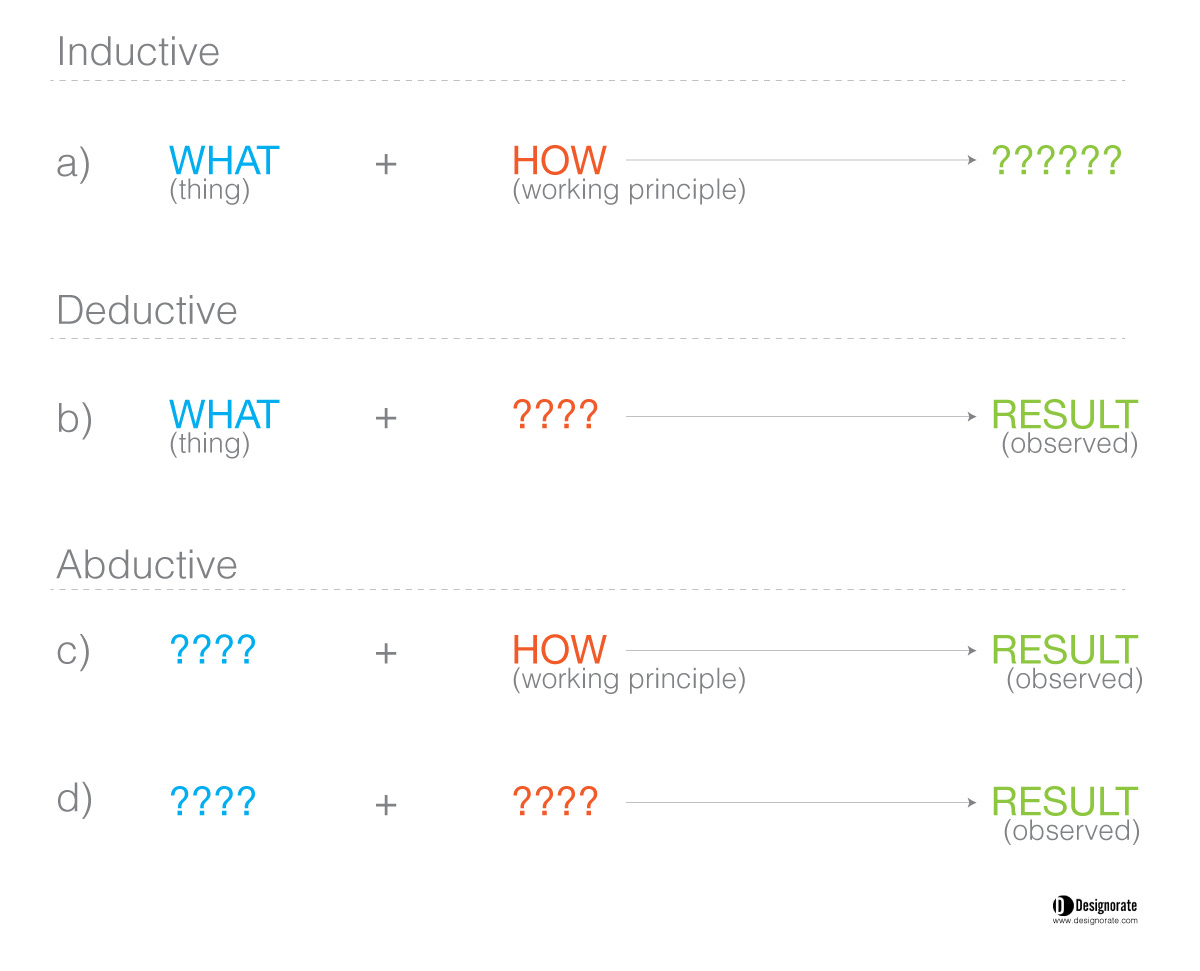
Dorst also highlights the importance of abductive reasoning in design. While deduction is about applying rules and induction is about identifying patterns, abduction is about imagining what could be. Designers often work with incomplete information. They must make creative leaps, propose possibilities, and test whether those possibilities create value. Frame innovation depends on this ability to connect a complex situation with a new way of approaching it.
For creative industries, business strategy, service design, and social innovation, this is particularly relevant. Organisations often say they want innovation, but many still define innovation as faster ideation, new technology, or more efficient delivery. Dorst’s book suggests something deeper. True innovation requires us to question the assumptions behind the brief. It asks us to look beyond the obvious version of the problem and consider whether we are solving the right problem at all.
This is where Frame Innovation becomes practical. The book does not treat framing as an abstract academic concept. Instead, it presents framing as a disciplined creative practice. It encourages designers and organisations to spend more time understanding the context, the stakeholders, the tensions, and the hidden assumptions that shape a situation. This can lead to more original and meaningful solutions.
However, the book also makes clear that frame innovation is not always easy to apply. Reframing requires time, patience, and openness. It asks teams to sit with uncertainty rather than immediately moving towards action. This can be difficult in organisations where speed, efficiency, and measurable outputs are prioritised. Many teams are under pressure to produce solutions quickly, and this pressure can limit the depth of their thinking. Dorst’s work is a reminder that rushing to solve a poorly framed problem often leads to shallow results.
The final part of the book is especially useful because it points towards action. Dorst discusses how frame innovation can be applied across different organisational and business contexts. This makes the book relevant not only for designers, but also for managers, educators, researchers, strategists, and anyone working with complex challenges.
Overall, Frame Innovation is an important contribution to design thinking because it shifts attention from solving problems to understanding how problems are constructed. It reminds us that the quality of a solution depends on the quality of the frame through which the problem is seen.